
◷ 2 minutes reading time (390 words)
When a Toy Sits Between Two Characters
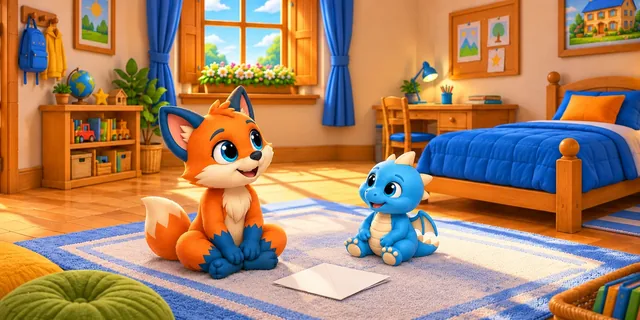
Bronto is often placed close to another character without speaking. The position matters to the scene: on a counter, beside a folded paper or near a place where Quzii has stopped.
When reading these passages, begin with placement and action. A toy's presence does not require an adult to invent the words it would say.
Follow the object through the passage
Choose one existing entry and read it all the way through. Then go back and find where Bronto first appears. Note who places him there, what he is near and whether that position changes.
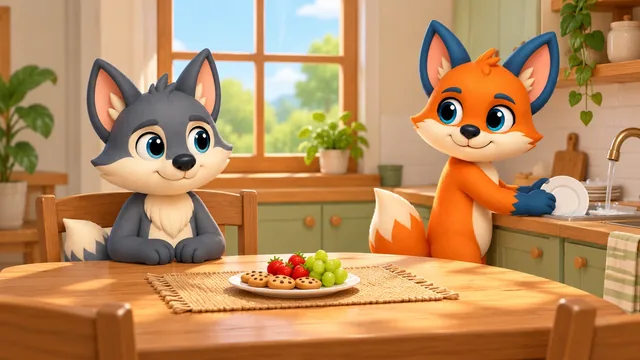
In Breakfast Without Eyes, Bronto is on the kitchen counter while Quzii is at the table and Luna is nearby. The writing uses that arrangement to hold several points of attention in one room.
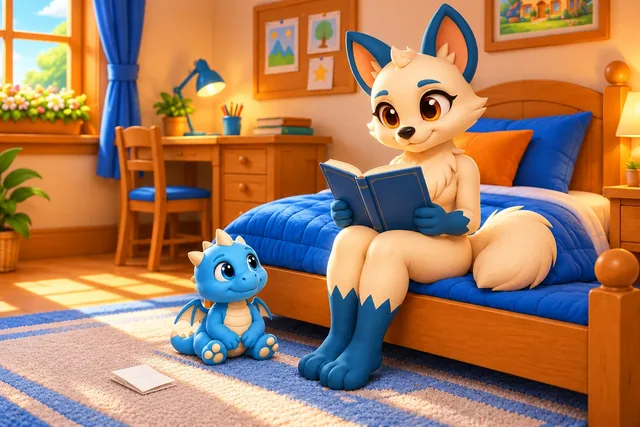
In The Presence That Doesn't Push, the folded drawing and Bronto's position become part of the scene. The drawing is not opened for the reader. Describing where it rests is different from explaining what is inside it.
Ask a question that the page can answer
“Where is Bronto now?” gives a reader a concrete place to begin. They can point to the line or describe the location. “What must Bronto be telling Quzii?” asks for an interpretation that the text may not establish.
Interpretations can still be discussed. Keep them in the reader's voice: “I read this as…” or “This makes me think…” Then look for the passage that prompted the idea.
You do not need to finish the conversation by asking for a similar event from the reader's own life. A fictional relationship can remain the subject of the discussion.
Keep a response separate from the story
If someone wants to arrange an ordinary toy beside a drawing after reading, make it clear that this is their activity. It is not a new scene in the book, and it does not have to reproduce Quzii's actions.
Ask before moving the arrangement or taking a photograph. Let the maker choose whether to explain it.
These reading suggestions concern fiction and a voluntary response to it. They do not establish a meaning for a real child's toy placement, drawing or silence, and they do not replace an adult's ordinary responsibilities for care and safety.
Read next
Related Posts
 Reading The Sorry That Didn't Feel Right: What Happens After the Apology?Bronto’s Reflections
 The Presence That Doesn't Push: Reading the Adult's RoleBronto’s Reflections
 What the Closed Drawer Leaves UnsaidBronto’s Reflections
 The Game We Made TogetherBronto’s Reflections
 The ‘Sorry’ That Didn’t Feel RightBronto’s Reflections
 The Toy Sat in the MiddleBronto’s Reflections